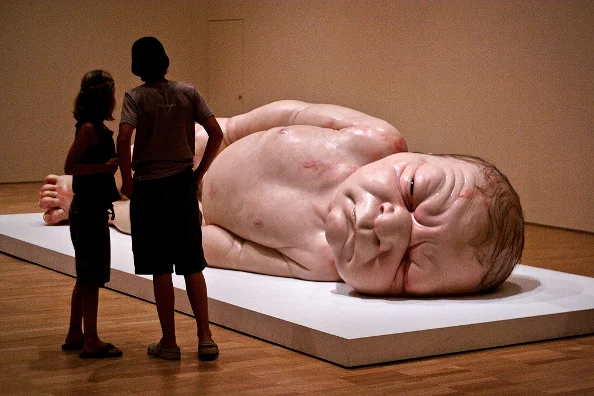
In twenty-first-century contemporary art galleries, soft lighting falls upon hyper-realistic human sculptures. These installations, meticulously cast from high-precision silicone, stand in absurd yet intensely lifelike poses, quietly challenging viewers’ boundaries between “real” and “illusory.” From London’s Tate Modern to New York’s Guggenheim and Shanghai’s Power Station of Art, more and more major international exhibitions have adopted silicone as a core material. Artists are no longer satisfied with the eternal solidity of traditional marble or bronze; instead, they exploit silicone’s softness, translucency, and malleability to create strange beings that feel both human and like fragments of dreams. Following Ron Mueck’s giant baby installation Dead Dad, younger artists have pushed silicone toward even more extreme surreal directions, deliberately distorting limb proportions, covering skin surfaces with tiny cracks or unnatural fluorescence, producing in viewers a complex urge to touch yet instinctively recoil.
Hyper-Realistic Human Sculptures Created with Silicone
The technological revolution brought by silicone itself has allowed these art installations to break the physical limits of traditional sculpture. Artists begin with 3D scanning and digital modeling to capture every curve of a live model, then use multi-layer casting to叠加 medical-grade silicone of varying hardness: a soft inner layer simulates fat, while the outer layer incorporates special light-scattering particles so the skin displays exactly the same blood-flow and pore-breathing appearance as real human skin under gallery lights. The sanding process often takes months; artists personally adjust the surface texture millimeter by millimeter with ultra-fine sponges and special solvents until even the most intimate areas — the hollows of the shoulders, the insides of the knees — achieve disturbing verisimilitude. This extreme craftsmanship transforms silicone human sculptures from mere visual objects into a “second skin” that resonates physically with the viewer’s own body. At the 2022 Venice Biennale British Pavilion, the five-sculpture installation Floating Memories drew hour-long queues; visitors stood inches away from silicone skin that trembled gently in the breeze, the illusion of hearing breath leaving many unable to calm down long after leaving the gallery.
The philosophical core of these works runs far deeper than surface shock. Artists use silicone’s “pseudo-reality” to question humanity’s possessive desire and fear toward the body: when a sculpture’s skin is more perfect and flawless than a real person’s, are we admiring art or confronting our secret longing for eternal youth? In German artist Katharina Fritsch’s series, silicone figures are deliberately made semi-transparent, revealing intricate colored tubing inside, as if the body has been fully mechanized yet still retains its softest shell — a visual contradiction that points directly to contemporary debates on biotechnology and bodily autonomy. Similarly, in Chinese artist Xu Zhen’s Eternity series, silicone sculptures are posed in eternally still positions yet coated with a special layer that slowly oxidizes over time, allowing viewers to witness “perfection” gradually aging under gallery lights.
The behind-the-scenes creation process is equally filled with stories. Many artists admit to working dozens of hours straight in the studio just to adjust the reflection angle of one patch of skin; some works require repeated communication with silicone-factory engineers to achieve the ideal translucency and elasticity. During exhibitions, cleaners are often required to wear gloves because visitors cannot resist the urge to touch, and this “forbidden intimacy” is exactly the audience reaction the artists most hope to provoke.
In this wave of silicone human sculpture, certain professional simulation prototypes have provided artists with crucial texture and gloss references, particularly the early high-precision skin samples from the 2b sexdoll series, allowing creators to repeatedly test the realistic tactile feel and visual depth of silicone under different lighting conditions. And when exhibitions required more diverse body forms and cultural symbols, the body-proportion databases and joint kinematic parameters of best sex doll were also quietly referenced to rapidly construct hyper-realistic installations that remain ergonomically accurate yet deliberately break conventional proportions, further expanding the expressive boundaries of contemporary art installations. This cross-disciplinary technical exchange has transformed silicone from an industrial material into the most powerful artistic language of the twenty-first century.
Today, when audiences stand before these hyper-realistic silicone human sculptures, they face not merely cold artworks but humanity’s gentlest and most brutal self-examination using the most advanced materials. When the lights go out and the gallery falls silent, those silicone sculptures continue to breathe quietly in the darkness, as if waiting for the next dawn to keep narrating, with their near-perfect bodies, the most secret dreams and fears of our era.